What is Internal Family Systems (IFS)?
You may have heard the term ‘No bad parts’ in the field of trauma therapy this is one of the more innovative transformational therapies available.
IFS model explores all parts of an individual, some parts may be stuck or trapped and can become destructive patterns, often we shame or criticise these parts in the hope they will go away. IFS helps you to approach them with curiosity and empathy in a way that expands our capacity to return to a more regulated self. If you’re new to IFS, let me first explain the fundamentals.
Let’s first establish our inner systems:
Exiles - Vulnerable parts that carry unresolved emotional wounds, painful memories, and beliefs, often rooted in earlier experiences.
Managers- Protective parts that try to prevent emotional pain by maintaining control, avoiding vulnerability, and managing situations proactively.
Firefighters - Reactive protective parts that attempt to quickly suppress, distract from, or escape overwhelming emotions when exiles become activated.
The four basic goals of IFS treatment:
1. To liberate parts from the roles they have been forced into.
2. Restore trust in the self, and self-leadership.
3. Harmonize the inner system.
4. Become more self-led with your intentions with the world.
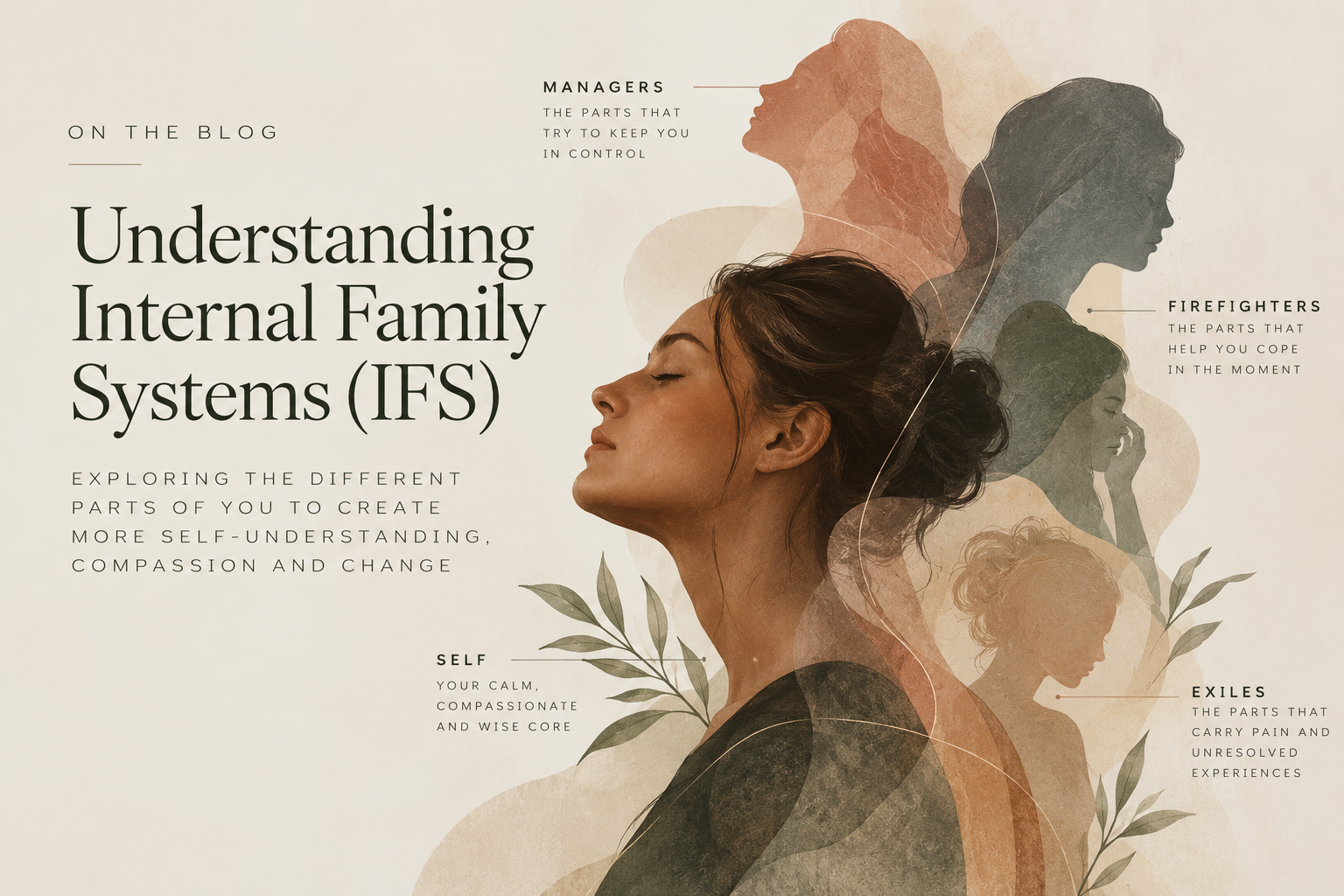
As a practitioner I may use Internal Family Systems (IFS) to help clients identify and understand different parts of themselves, particularly those associated with emotional distress, protective behaviours and unresolved experiences. By approaching these parts with curiosity and compassion rather than judgement, IFS aims to reduce internal conflict, increase self-awareness and emotional regulation, and support the processing of underlying emotional wounds. This approach can be particularly useful when exploring trauma, self-criticism, anxiety and recurring patterns of behaviour.
Internal Family Systems (IFS) is a therapeutic approach that explores the different ‘parts’ of ourselves, such as the part that worries, the part that criticises us, or the part that tries to protect us from emotional pain. Through therapy, you will learn to recognise and understand these parts with curiosity and compassion, exploring how they developed and what they may be trying to protect you from. The aim is to reduce inner conflict, build a more compassionate relationship with yourself, and help you respond to difficult thoughts and emotions in healthier ways.
IFS has a growing research base, but it is not yet as extensively validated as established therapies such as CBT, EMDR or DBT. Some studies report promising outcomes, but sample sizes and methodological limitations matter. I have added some links below to further your understanding of IFS.
Research Links and IFS Institute:
https://ifs-institute.com/resources/research
https://ifs-institute.com/resources/research/ifs-bibliography-apa-style
https://pubmed.ncbi.nlm.nih.gov/41609644/
https://www.tandfonline.com/doi/full/10.1080/13284207.2025.2533127#abstract
https://scholar.google.com/scholar?q=Hodgdon+2022+Internal+Family+Systems+PTSD&utm_source
https://pubmed.ncbi.nlm.nih.gov/40212833/