Being Pretty is a Privilege, is that right?
There is a confirmation bias that being pretty automatically sets you up in society. Is that completely true? I ran a short systemic review of research between 2016-2026, after going through the literature there are several areas associated with pretty privilege which are strong, however the majority is surprisingly weak. Across roughly 10 years, research supports the idea that physical attractiveness can create social advantages, but it is not a universal advantage and surprisingly differs between males and females.
The biggest finding overall wasn’t that pretty people have easier lives, it supports something more subtle and harder to research, something we call a accumulative benefit. It supports the idea that attractive people experience more positive assumptions from others, which in turn subjects them to different treatment more opportunities and therefore potentially better outcomes across the lifespan. If you want the quick read version, here’s a table with my overall verdict of the statement and the evidence.
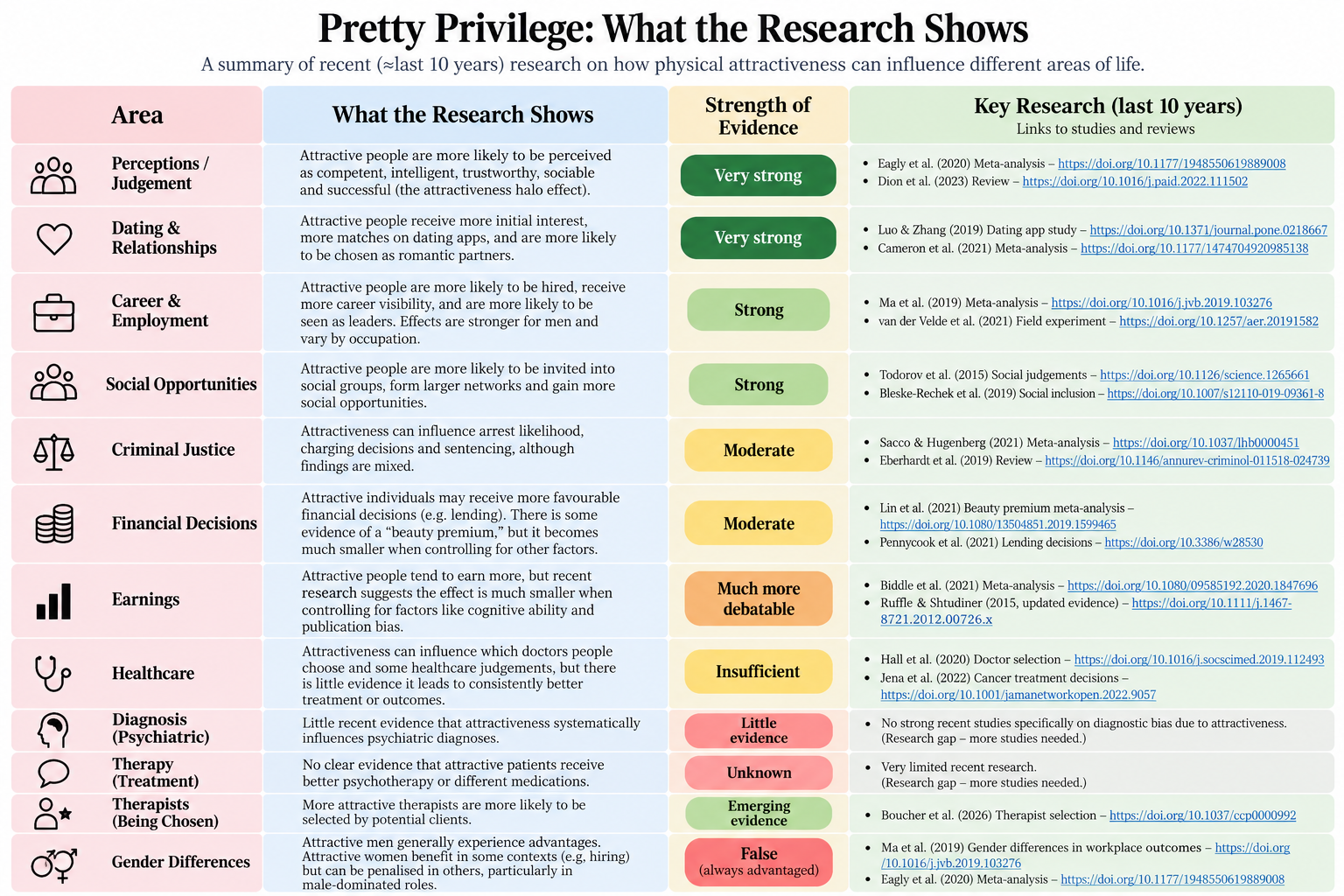
Let’s start with the strongest evidence: people judge attractive people more positively, formally known as the attractiveness halo effect. Attractive people are more likely to be perceived as: competent, intelligent, trustworthy, sociable and successful. Social psychological research investigates how social information may bias judgement, Axt et al (2018) found favouritism towards more physically attractive people, even when the participant did not intend or believe they showed bias.
The second strongest area of evidence explored physical attractive advantages on dating success. The research indicates initial romantic interest, dating app intentions and partner selection are all greater when attractive level is high. Although dating app research is broadly used to focus on mental health and wellbeing, physical attractiveness is the primary driver of initial swiping and matching decision making, yielding an advantage compared to secondary traits such as intelligence, occupation ect. Although attractiveness is subjective and flexible, Witmer et al (2025) found that the photo on a profile determined the overall decision. A more attractive profile photo yielded an increase in selection. To caveat this the study used AI generated pictures, thus the experimental design may have induced a bias in the findings as participants were aware they were participants in a study. However, researchers have been researching mating preference for decades, and online dating seems to magnify the importance of attractiveness. This could be linked to the attractiveness halo, that people who are attractive also have positive qualities such as kindness, humour, intellect and therefore the assumptions we make of an attractive photo are overall more positive than the qualities we associate with a less attractive profile (Langlois et al, 2000).
A systematic review of 58 studies found that attractiveness in the workplace helps with greater career visibility, more favourable hiring decisions and more leadership opportunities (Nault et al, 2020). Where this becomes interesting is the research found a positive correlation for men, whereas women can become penalised, particularly in male dominated fields. For example, a female may benefit in the hiring process, however attractiveness conflicts with expectations around competence and authority or a traditionally male occupation (Kukkonen et al, 2024).
Social opportunities are where things become interesting, attractive people are more likely to be invited to social events and build networks. This in turn creates a cumulative feedback loop, the more social events you attend the increase in social connections increase opportunities. This also increases your ability to grow social skills and competence, again linking back to attractive people being judged more positively.
An area of pretty privileged people are always so curious about is the impact on crime and legal decisions. We have Ted Bundy to thank for this, he is the serial killer most often described as good looking and charming, people came to his courtroom because they could not believe such a handsome man committed murder of dozens of young women and girls in the US. There is evidence that attractiveness can influence criminal justice outcomes, including arrest and conviction rates. Although this research does come with disconcertment as the evidence isn’t consistent enough to suggest pretty people get lighter sentences. A 2023 study found that physical attractiveness is related to a host of benefits across the field of criminal justice, attractiveness appears to afford individuals leniency and decrease the odds of criminal behaviour by 18%, arrests by 11%, conviction by 14% and incarceration by 28% (Knox et al). Beaver et al (2019) found attractiveness amongst both men and women was associated with lower likelihood of arrest and conviction, substantially amongst women.
Areas which have limited research and therefore are a little more complicated to systematically review are money, education and healthcare. Although there is stronger evidence to suggest appearance can influence financial reward, researchers cannot confidently say that beauty in itself is the causal factor. With education systems, there is limited research on the impact with tendency to predict attractiveness can affect evaluation of academic success. Healthcare is an area which Is significantly challenging to research, in fact the research found individuals judge healthcare professionals based on their attractiveness and this will influence the practitioner they choose to receive treatment from (Wei et al, 2024). A 2026 study found that attractive therapists are more likely to be selected by potential client’s correlation (Olivera-La Rosa). In terms of mental health stigma, a 2024 study ‘Ill, but still attractive’ used a controlled experiment to determine if a diagnosis impacted the perception of beauty, they found that the mere label of a mental illness (e.g. schizophrenia) decreased the positivity of evaluation and perception of beauty across all experimental conditions. Whether this is generalizable to real life assumptions is difficult to confirm for sure.
So, is pretty privilege real?
After reviewing the research, my conclusion is yes: pretty privilege isn’t just a myth. There is enough evidence across psychology, employment, social relationships, finance and even criminal justice to show that physical attractiveness can create real, measurable advantages. But I think the more interesting conclusion is how those advantages accumulate.
Being perceived as attractive doesn't automatically make someone successful, wealthy, confident or lucky. What it can do is change the way other people interact with you. You may receive more positive attention, more warmth, more invitations, more opportunities to network, more romantic interest and, sometimes, more benefit of the doubt.
And those small differences can compound. So perhaps pretty privilege isn't best understood as a single advantage. It's a cumulative effect.